

The health benefits of walking are backed by more rigorous research than almost any other form of exercise, yet walking still gets treated as the thing you do when you can’t be bothered to do “real” exercise. It has no equipment, no membership, and no learning curve — and for exactly those reasons, its actual impact is underrated.
The research disagrees, but not in the way most wellness articles suggest. The honest picture is more interesting: the famous 10,000-step target was invented by a marketing department, the benefits start far earlier than you’ve been told, and they plateau sooner than you’d expect. Here’s what large studies — including a landmark 2025 meta-analysis and a brand-new 2026 UK Biobank study — actually support.
What happens to your body when you walk?
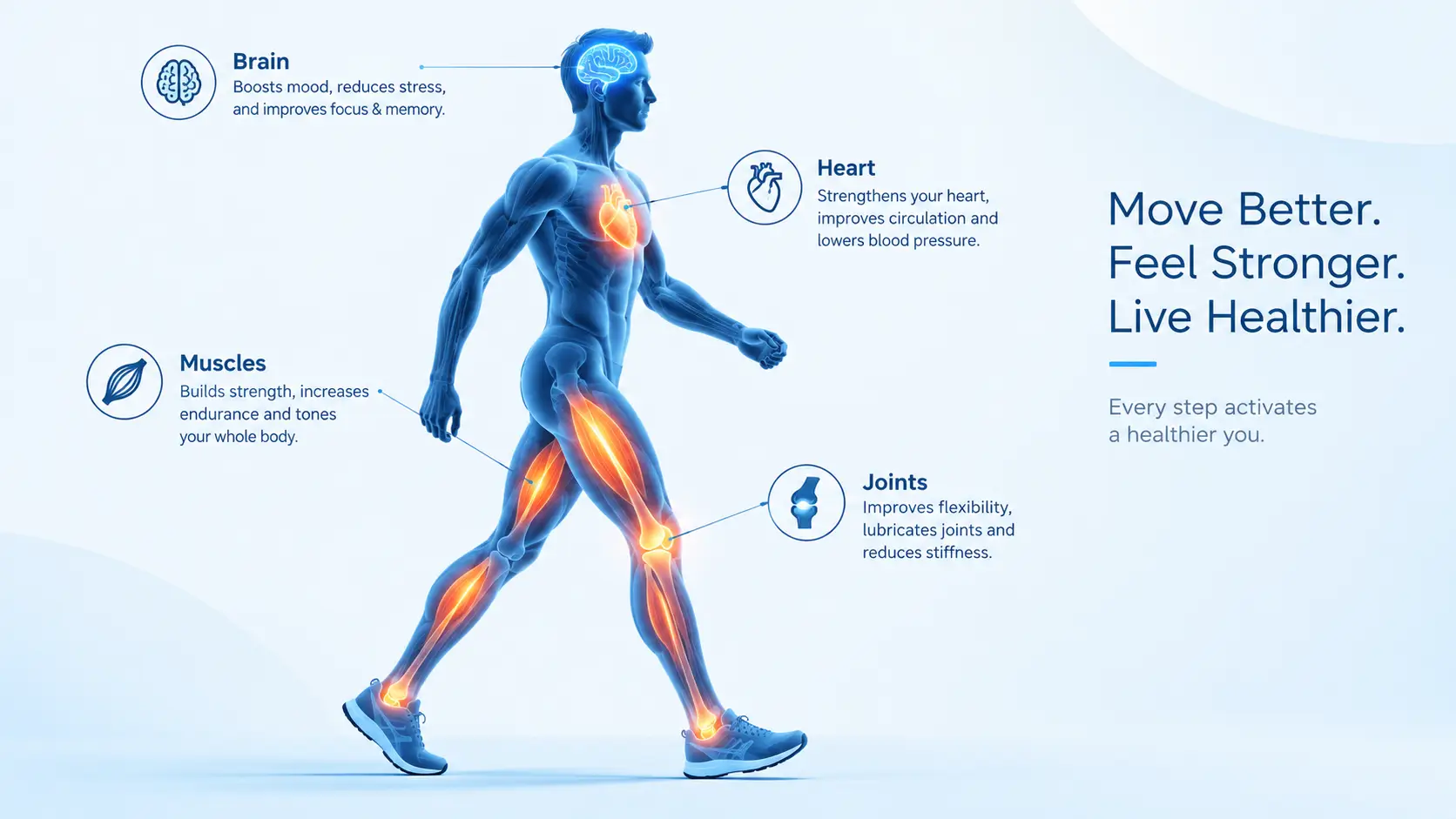
Walking looks simple from the outside, but it triggers a chain reaction across nearly every system in your body at once.
Heart and blood vessels
Your heart rate rises, blood vessels dilate, and nitric oxide levels increase — which helps relax arteries and improves how efficiently blood moves through your body. Over weeks and months, this translates into a stronger, more efficient heart, lower resting blood pressure, and improved cholesterol ratios.
Muscles and metabolism
Walking stimulates lipoprotein lipase, an enzyme in leg muscles that helps clear fat from the bloodstream, while your muscles pull glucose out of circulation more efficiently. This is part of why a short walk can blunt a blood sugar spike (more on that below).
Bones and joints
One of the underrated health benefits of walking is bone strength: it’s weight-bearing exercise, meaning your bones work against gravity with every step. This stimulates bone-building cells and helps maintain bone density. It also keeps synovial fluid circulating in your joints — cartilage has no direct blood supply, so movement is one of the only ways it gets nourished and cleared of waste.
Brain
Walking raises levels of brain-derived neurotrophic factor (BDNF), a protein that supports the growth of new neural connections, particularly in the hippocampus — the brain region tied to memory and learning. Muscles also release proteins called myokines during walking, which appear to support brain resilience and communication between brain cells.
Hormones and mood
Walking measurably lowers circulating cortisol (the primary stress hormone), which is part of the physiological basis for the mental health effects covered later in this article.
None of these systems work in isolation — they reinforce each other, which is a large part of why walking shows up as protective across such a wide range of unrelated health outcomes.
Walking and heart health
Cardiovascular disease is where the health benefits of walking are documented most deeply, and the numbers are larger than most people expect.
The 2025 Lancet Public Health dose-response meta-analysis, led by Professor Ding Ding at the University of Sydney, pooled 31 studies across 34 cohorts. Compared with a sedentary 2,000 steps a day, 7,000 steps a day was associated with a 47% lower risk of cardiovascular death and a 25% lower risk of developing cardiovascular disease in the first place. The inflection point — where the curve of diminishing returns kicks in — sat around 7,800 steps for cardiovascular disease incidence in younger adults, shifting down to about 5,400 steps for older adults.
A separate 2023 meta-analysis in the European Journal of Preventive Cardiology, covering roughly 227,000 people, found each additional 500 daily steps was linked to a 7% lower risk of cardiovascular mortality, with measurable benefit appearing at just 2,337 steps a day.
Everyday physiology backs this up: regular walking is associated with systolic blood pressure reductions in the range of 3–7 mmHg and modest improvements in HDL (“good”) cholesterol — changes that, sustained over years, meaningfully lower cardiovascular risk.
Walking and blood sugar

Among all the health benefits of walking, this is where the evidence gets most surprising, because the effective dose is tiny.
A 2022 systematic review and meta-analysis in Sports Medicine by Aidan Buffey and colleagues at the University of Limerick pooled seven trials comparing prolonged sitting against standing breaks and light walking breaks. Light-intensity walking breaks cut post-meal glucose by roughly 17% compared with uninterrupted sitting — standing helped too (about 9.5%), but didn’t improve insulin levels the way walking did. The walking breaks in these trials lasted just two to five minutes.
Timing matters as much as duration. A 2016 trial in Diabetologia found that 10-minute walks after each main meal lowered post-meal glucose more effectively than a single 30-minute walk taken at another time of day, with the post-dinner walk doing most of the work. A 2013 Diabetes Care study in older adults at risk of impaired glucose tolerance found three 15-minute post-meal walks beat one 45-minute morning walk for 24-hour glycaemic control.
The mechanism lines up with what’s happening at the muscle level: walking pulls glucose directly into working muscle, blunting the peak before it happens. Research suggests starting within about 30 minutes of eating is optimal — wait too long and the glucose peak has already occurred.
Practical takeaway: if you do nothing else differently, move fifteen minutes of the walking you already do to right after your largest meal of the day.
Walking and weight management

When it comes to the health benefits of walking, this is the section where an honest article has to disappoint you a little.
Walking burns real calories — roughly 0.5 kcal per kilogram of body weight per kilometre, compared to about 1.0 kcal/kg/km for running. But as a standalone weight-loss tool, walking (and exercise generally) underdelivers relative to expectations, and it isn’t a failure of willpower — it’s physiology.
A 2026 study in Communications Medicine put sixteen sedentary adults with overweight through twelve weeks of supervised aerobic walking and measured total energy expenditure using doubly labelled water. Body weight barely moved. The body compensated by lowering resting energy expenditure, walking more efficiently, and even shrinking metabolically expensive organs like the liver and kidneys by about 5%. Interestingly, food intake didn’t increase — the compensation was metabolic, not behavioural.
Broader reviews of exercise interventions in people with obesity find average weight loss versus non-exercising controls of around 2 kg — real, but far short of what most people hope for from exercise alone.
Where walking does earn its place is in maintaining weight loss rather than producing it. After weight loss, resting energy expenditure drops more than the lost weight alone would predict, which drives regain; regular walking raises total daily energy expenditure enough to partially offset that.
The honest framing: walk for your heart, your blood sugar, and your mood — not for the number on the scale. Judging walking by weight loss alone measures the right habit with the wrong instrument. Pairing a walking habit with the fundamentals in our balanced nutrition guide is a more realistic path to lasting weight management.
Walking and mental health
A 2022 meta-analysis in JAMA Psychiatry by Matthew Pearce and colleagues pooled 15 prospective studies covering 191,130 participants and more than two million person-years, examining physical activity and the risk of developing depression.
Adults doing the equivalent of 2.5 hours of brisk walking per week had a 25% lower risk of depression compared with adults reporting no physical activity. Half that volume — about 1.25 hours a week, roughly eleven minutes a day — was associated with an 18% lower risk.
The dose-response curve has the same shape seen throughout this article: most of the benefit came from moving from zero activity to some activity, with comparatively little additional gain from pushing further. The authors estimated that around one in nine cases of depression could be prevented if the whole population met current activity guidelines.
This is prevention research describing population-level risk, not treatment research — it isn’t a substitute for professional care if you’re currently unwell. If stress rather than mood is your main concern, our guide to stress management techniques covers other approaches that pair well with a daily walk.
How many steps do you actually need?
The honest answer: fewer than you’ve been told. To capture most of the health benefits of walking, the number that matters most depends on where you’re starting from.
The 2025 Lancet Public Health meta-analysis found that approximately 7,000 steps per day was associated with meaningful risk reductions across every outcome examined — all-cause mortality, cardiovascular disease, cancer, type 2 diabetes, dementia, depression, and falls — and could serve as a practical public health target. Beyond 7,000, the risk curve flattened for several outcomes, including cardiovascular mortality, though it kept improving modestly for others.
Critically, the curve is steepest at the low end. The 2023 European Journal of Preventive Cardiology meta-analysis found meaningful benefit appearing below 4,000 steps for all-cause mortality and around 2,300 steps for cardiovascular mortality — figures well under the 5,000-step line often used to define a “sedentary” lifestyle.
The practical translation: the jump from 2,000 to 4,000 steps matters more, per step, than the jump from 8,000 to 10,000. If you’re starting from very little, that’s where nearly all your return on effort is sitting.
| Daily Steps | Associated Risk Reduction (vs. 2,000 steps) | What It Looks Like |
|---|---|---|
| 2,300–4,000 | Meaningful drop in cardiovascular mortality begins | A 20–30 minute walk, or an active daily routine |
| 5,000–7,000 | ~47% lower all-cause and cardiovascular mortality | 30–45 minutes of brisk walking, or steady daily movement |
| 7,500–10,000 | Curve flattens for most outcomes; lowest overall risk band | 45–75 minutes total daily walking |
| 10,000+ | Little additional benefit for most outcomes | Fine if enjoyable, not necessary for health returns |
Based on pooled findings from Ding et al. (2025, The Lancet Public Health) and Banach et al. (2023, European Journal of Preventive Cardiology). Figures are approximate and vary by age and baseline health.
Is 30 minutes of walking enough?
For most healthy adults, yes — and this is enough to capture most of the health benefits of walking, lining up with official guidance and not just step-count research.
The World Health Organization recommends adults get 150–300 minutes of moderate-intensity aerobic activity per week (or 75–150 minutes of vigorous activity), which works out to roughly 30 minutes a day, five days a week, at the low end of the range. Walking briskly enough that your breathing is noticeably heavier but you can still talk in short sentences counts as moderate intensity.
A single 30-minute brisk walk burns roughly 150–200 calories for most adults and is enough, done daily, to trigger the cardiovascular, metabolic, and bone-health adaptations described earlier in this article. It’s also consistent with the step-count evidence above: most people walking briskly for 30 minutes will land somewhere in the 3,000–4,000 step range for that session alone, which — stacked on top of ordinary daily movement — gets most people close to or past the 7,000-step target associated with the largest risk reductions.
Thirty minutes is a floor, not a ceiling. More is fine if you enjoy it and your body tolerates it well, but the evidence doesn’t support believing you’re wasting your time at 30 minutes while waiting to “do enough.”
Walking vs. running
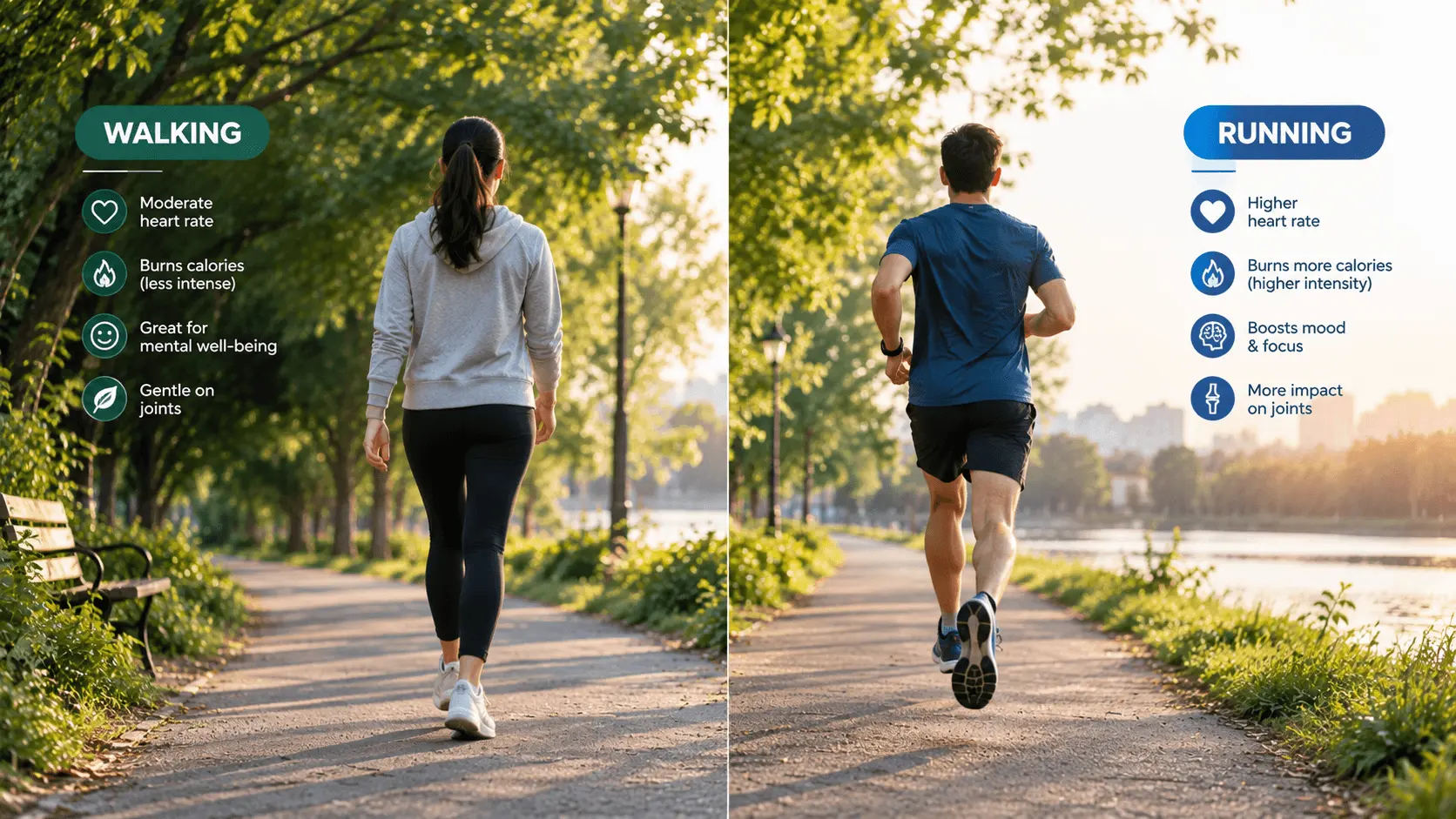
The comparison people expect is “running is just better, faster,” which skips over how the health benefits of walking actually stack up. The research says something more interesting.
Running does burn more calories per kilometre — roughly double the rate of walking (about 1.0 kcal/kg/km versus 0.5 kcal/kg/km) — so if your only goal is calorie burn per minute spent, running wins on efficiency.
But a landmark study from the Lawrence Berkeley National Laboratory, comparing 33,060 runners and 15,045 walkers over six years, found that when energy expenditure was equalised — comparing people who burned the same total calories, regardless of how long it took — walking and running produced statistically comparable reductions in cardiovascular risk factors. In fact, on some measures, walkers showed slightly larger risk reductions per unit of energy expended than runners did, for hypertension, cholesterol, and coronary heart disease specifically.
The catch: to match a 30-minute run calorie-for-calorie, you need a meaningfully longer walk — often 45–60 minutes depending on pace.
Where the two diverge most clearly is injury risk. Running is higher-impact and carries a greater risk of injury to knees, hips, and lower back, particularly for people returning from a long break, managing existing joint issues, or new to structured exercise. Walking is the lower-risk on-ramp, and for many people — especially those managing joint pain, higher body weight, or older age — it delivers comparable cardiovascular benefit with substantially less injury risk.
The practical rule
If you already run and enjoy it, keep running — the cardiovascular and mortality data on running are also strong. If you don’t run, don’t feel you’re missing out on some walking couldn’t replace; you’ll just need to walk a bit longer to match it.
How to start a daily walking routine
The health benefits of walking only add up if the habit survives a busy week. A few evidence-aligned starting principles:
- Start from wherever you actually are. If you’re currently under 3,000 steps a day, your first goal is 4,000–5,000, not 10,000. This is where the research shows the steepest returns.
- Anchor it to an existing habit. A walk right after breakfast, right after your commute, or right after your largest meal (see the blood sugar section above) is far more likely to stick than a walk you have to specifically carve out time for.
- Use pace as your second lever, not your first. Once a daily walk is a habit, picking up the pace — aiming for around 100 steps per minute, or brisk enough that talking takes some effort — adds cardiovascular benefit without adding time.
- Split it up if 30 minutes feels like too much at once. WHO guidance explicitly allows bouts of at least 10 minutes; three 10-minute walks count the same as one 30-minute walk for weekly totals.
- Track trend, not precision. Wrist-worn trackers count steps differently from the waist- or hip-worn devices used in most research. Use your own device consistently as a personal baseline to improve on, rather than comparing its raw number to a study figure.
- Protect the streak over the distance. A short walk every day builds the habit that a long walk twice a month never will. Consistency is doing most of the work in every study cited in this article.
For more everyday habits that stack well with walking, see our broader guide to healthy living habits.
What the latest research says
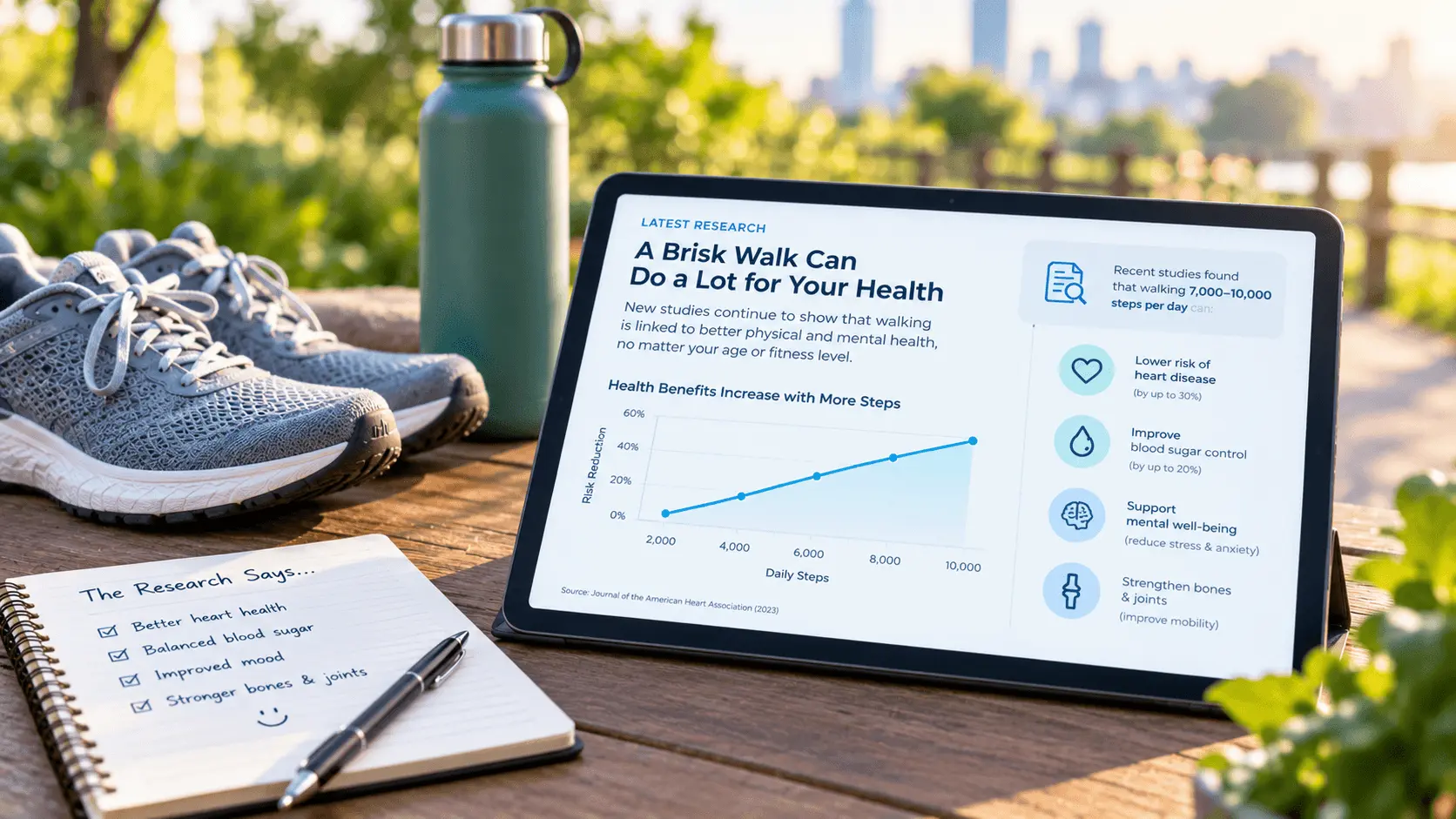
Two recent studies are reshaping how researchers think about the health benefits of walking, and both are recent enough that most existing advice online hasn’t caught up.
The 2025 Lancet Public Health meta-analysis (Ding et al.)
This is the most comprehensive synthesis to date — 57 studies systematically reviewed, 31 pooled in meta-analysis, covering outcomes far beyond mortality: cardiovascular disease, cancer, type 2 diabetes, cognitive decline, depression, physical function, and falls. Its central conclusion is that roughly 7,000 steps a day, not 10,000, is a defensible, evidence-backed public health target for most adults.
The September 2026 British Journal of Sports Medicine study (Stamatakis et al.)
Led by Emmanuel Stamatakis at Monash University, this study addressed a question step-count research had left open: does pace matter independently of volume? Analysing 103,684 UK Biobank participants tracked over roughly eight years, the researchers found that people taking fewer than 5,000 steps a day at a brisk cadence (80+ steps per minute) had mortality risk comparable to people taking 5,000–7,500 steps at a leisurely pace. The lowest risk overall sat at 7,500–10,000 steps a day, regardless of pace. The takeaway, in Stamatakis’s own words, is “behavioural flexibility” — step volume and stepping intensity are two separate, largely interchangeable levers, and the right combination is whichever one a person will actually sustain.
Both studies are observational — they show strong, consistent associations across huge samples, not proof of direct cause and effect. Reverse causation is a real limitation: people who are already ill tend to walk less, which can make walking look more protective than it is. Well-designed studies handle this by excluding early deaths and adjusting for baseline illness, but it’s worth holding the numbers with appropriate humility rather than treating them as guarantees.
Correct — 10,000 was a 1965 marketing number for a Japanese pedometer, not a research finding. Current large-scale evidence shows the health benefits of walking plateau for most outcomes at roughly 7,000 steps a day for most adults.
That’s still meaningful. The steepest part of the risk-reduction curve sits between roughly 2,000 and 4,000 steps, so increases in that range matter more, per step, than increases at the higher end.
Both work, and they’re largely interchangeable. If time is limited, walking faster is more time-efficient. If pace is difficult for you — due to joints, balance, or fitness level — walking more at a comfortable pace gets you to a similar place.
Modestly, not dramatically. The body compensates for exercise-induced calorie burn in ways that blunt weight loss from walking alone. It’s genuinely valuable for maintaining weight loss achieved through diet, and for cardiovascular and metabolic health regardless of what happens on the scale.
After — specifically within about 30 minutes of eating, for the biggest effect on blunting your blood sugar spike. Even 2–5 minutes helps; 10–15 minutes helps more.
Calorie-for-calorie, walking and running produce comparable cardiovascular benefits, though running burns more calories per minute. Walking carries a meaningfully lower injury risk, which matters most for beginners, older adults, and anyone with existing joint concerns.
For most healthy adults, yes — it sits at the low end of the WHO’s recommended 150–300 minutes of moderate activity per week and is enough to trigger the cardiovascular and metabolic adaptations described in this article. You can also split it into shorter 10-minute bouts.
This article summarises published research for general information. It isn’t medical advice. If you have a heart condition, diabetes, joint problems, or you’re starting exercise after a long break or a health event, talk to your doctor about what’s appropriate for you.
Taken together, the health benefits of walking hold up across cardiovascular disease, blood sugar control, weight maintenance, and mental health — provided the target is realistic and the habit is consistent.
Key sources
- Ding D, Nguyen B, Nau T, et al. Daily steps and health outcomes in adults: a systematic review and dose-response meta-analysis. The Lancet Public Health. 2025;10(8):e668–e681.
- Banach M, Lewek J, Surma S, et al. The association between daily step count and all-cause and cardiovascular mortality: a meta-analysis. European Journal of Preventive Cardiology. 2023;30(18):1975–1985.
- Stamatakis E, et al. Daily steps, stepping intensity and mortality. British Journal of Sports Medicine. Published online 8 September 2026.
- Buffey AJ, Herring MP, Langley CK, Donnelly AE, Carson BP. The acute effects of interrupting prolonged sitting time in adults with standing and light-intensity walking on biomarkers of cardiometabolic health. Sports Medicine. 2022;52(8):1765–1787.
- Pearce M, Garcia L, Abbas A, et al. Association between physical activity and risk of depression: a systematic review and meta-analysis. JAMA Psychiatry. 2022;79(6):550–559.
- Reynolds AN, et al. Advice to walk after meals is more effective for lowering postprandial glycaemia in type 2 diabetes mellitus than advice that does not specify timing. Diabetologia. 2016;59(12):2572–2578.
- Williams PT, Thompson PD. Walking versus running for hypertension, cholesterol, and diabetes mellitus risk reduction. Arteriosclerosis, Thrombosis, and Vascular Biology. 2013;33(5):1085–1091.
- Multilevel metabolic adaptation to exercise training. Communications Medicine. 2026.
- World Health Organization. WHO guidelines on physical activity and sedentary behaviour. 2020.