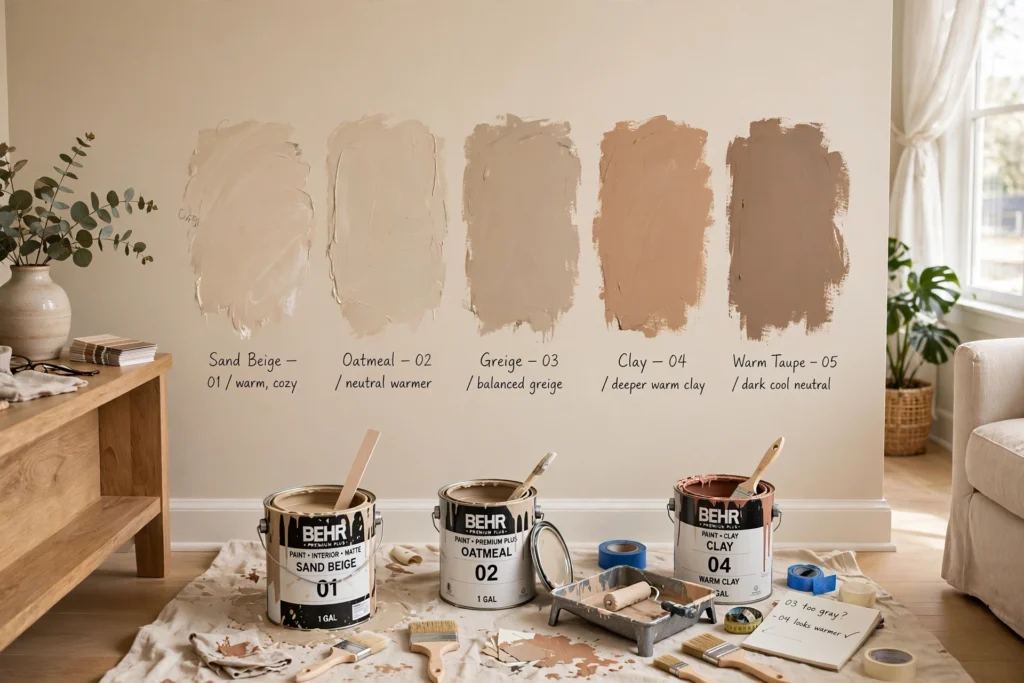
Paint looks different on your wall than it does on a small card in the store. The card is lit by store lights. Your wall is lit by your own windows, your lamps, and the floor and furniture around it. That is why so many rooms end up a shade too cold, too dark, or just not what you pictured.
This guide shows you how to choose paint colors for beginners in the right order: light first, undertones second, palette third, and testing before you buy a full gallon. You don’t need a designer, and you don’t need to repaint your whole house to get it right.
Quick Answer: How Do You Choose a Paint Color?
To choose a paint color, check how your room’s light changes during the day, match the paint’s undertone to your floor or other fixed elements, build a simple palette (60% main color, 30% secondary, 10% accent), and test large samples on the wall for at least a day before buying. Then pick a finish that suits how the room is used.
The seven steps below explain each part in plain language.
Color Basics You Actually Need (and Nothing More)
You can skip the color wheel lecture. Three ideas are enough to make good decisions.
Undertone is the subtle hidden tint inside a color. A white can lean yellow, pink, blue or green. Two grays that look identical on a card can have very different undertones once they are on your wall.
Value is how light or dark a color is. Dark values make a room feel cozy and enclosed. Light values make it feel open.
Light Reflectance Value (LRV) is a number from 0 (absorbs all light) to 100 (reflects all light), printed on the back of many paint chips and on manufacturer websites. A higher LRV means the paint reflects more light. It is a quick way to compare two colors for a dim room: a paint with an LRV in the 70s or higher will bounce much more light around than one in the 30s.
1. Start With the Light in Your Room
Before you look at color charts, look at your room at three times of day: morning, afternoon, and evening with the lamps on.
In the Northern Hemisphere, a north-facing room gets cooler, bluer light, while a south-facing room gets warmer, brighter light. East-facing rooms are bright and warm in the morning and softer later. West-facing rooms turn golden in the evening. The same paint can look calm in one room and cold in another.
This is why choosing paint colors for a room starts with light, not with a favorite shade.
- Dark or north-facing room: A light warm neutral usually works better than a stark white, which can look gray in low light. If you want a deep color, choose it knowingly for a cozy effect.
- Bright south-facing room: You have more freedom. Cooler colors, and deeper colors, tend to hold up well.
- Your light bulbs matter too. Warm bulbs (around 2700K) bring out yellows and reds. Cool daylight bulbs (5000K) make colors look cooler and flatter. Check your samples under the bulbs you really use at night.
Checking light at three times of day is the first habit in how to choose paint colors for beginners, because no shade can be judged without it.
2. Match the Undertones to What Is Already There
Your floor, countertops, fireplace and large sofa are fixed elements. You are not changing them for a paint job, so the new color has to get along with them.
Hold paint samples next to the biggest fixed element, usually the floor. If the floor leans yellow or orange, a cool blue-gray wall will clash, even if you like both colors on their own.
The simple rule is warm with warm, cool with cool.
How do you find a color’s undertone?
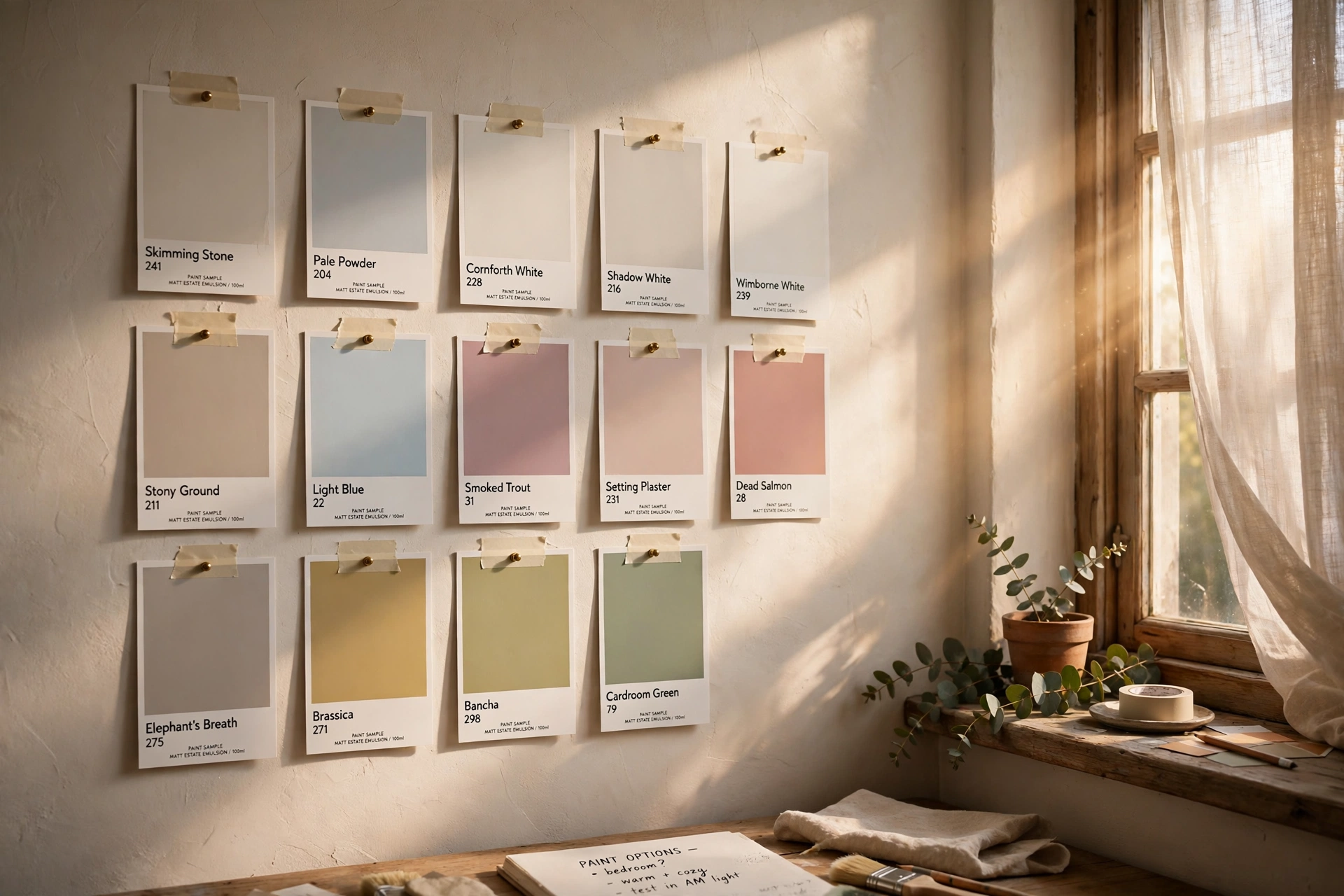
Place the paint chip on a plain sheet of bright white printer paper in daylight. Look at what the color seems to lean toward. Hints of yellow, red, orange or peach point to a warm undertone. Hints of blue, green, violet or a steely gray point to a cool one. You don’t need to name the undertone perfectly. You only need to see whether the sample and your floor look comfortable together in daylight.
Be careful with white and gray
Whites and grays show undertones the most, which is why “just choosing a white” is harder than it sounds. A warm white with a creamy tint is forgiving in most homes. A very crisp, bluish white can feel cold and stark in a room with little sun. When you compare several whites, put them next to each other so the differences show.
Getting undertones right is the quiet skill inside how to choose paint colors for beginners, and it prevents the most common clash.
3. Build a Palette With the 60-30-10 Rule
Use about 60% of the room in a dominant color (walls and large furniture), 30% in a secondary color (curtains, chairs, rug), and 10% in an accent (pillows, art, a vase). It works because the eye gets a calm base, a supporting layer, and a few points of interest.
Example: warm white walls and a light wood floor make up the 60. A sage-green chair and curtains are the 30. Rust pillows and a brass lamp are the 10. Everything else, such as books, frames and plants, can pull from those three families without further thought.
If you feel stuck, start with something you already own, like a rug, a piece of art or a favorite fabric, and pull your wall color from one of the quieter shades in it. That gives you a palette that already works.
Starting from something you already own is a simple shortcut in how to choose paint colors for beginners, because the palette already works.
4. Test Large Samples, Not Small Cards
Never choose from a card alone. A card is a few square inches, surrounded by white paper, and it cannot show how a color behaves across a whole wall.
How to test paint samples properly:
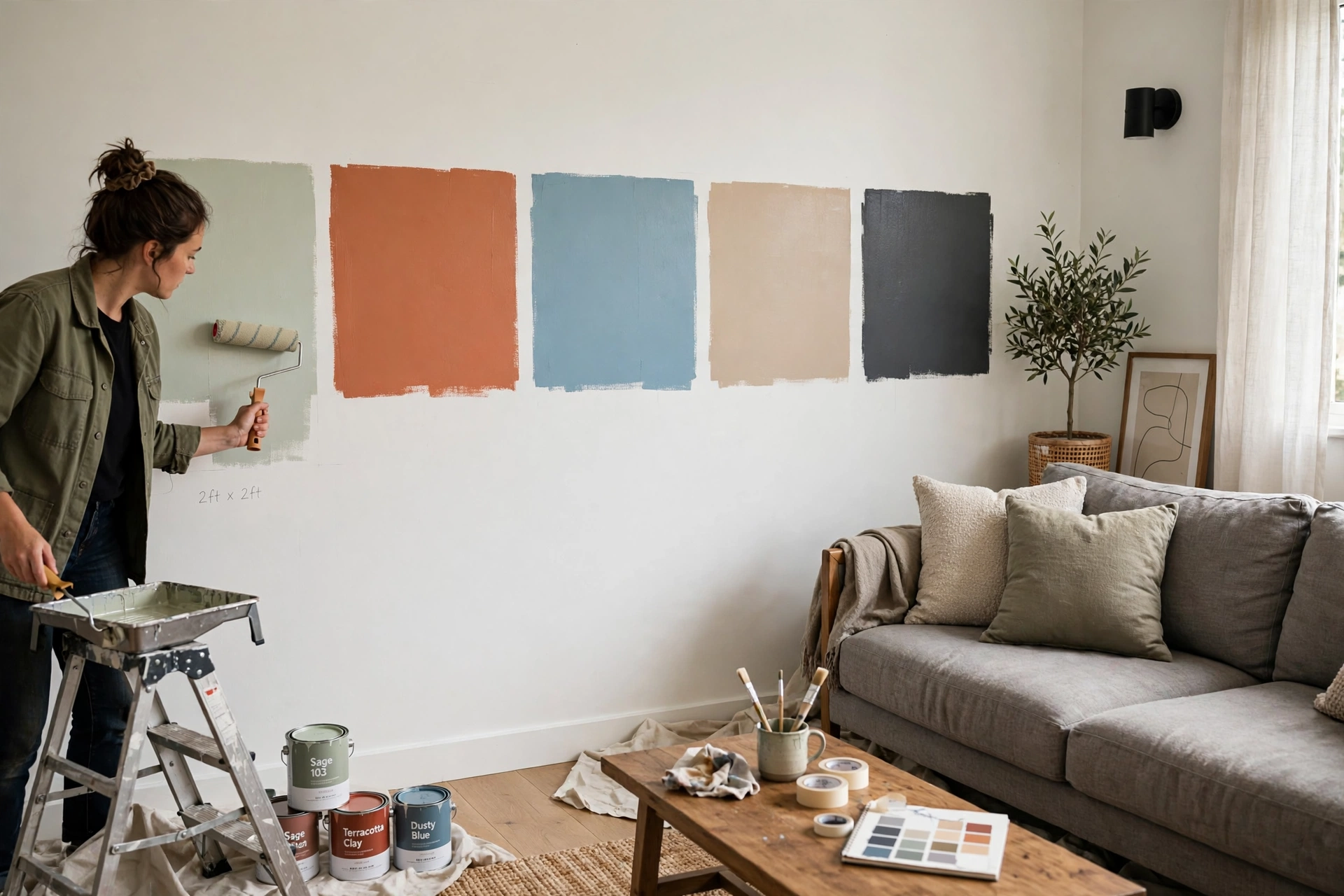
- Paint a sample about two feet square, or paint a large piece of white poster board so you can move it around the room.
- Put two or three finalists side by side, with a little white space between them.
- Check them in morning light, afternoon light and under lamps at night.
- Look at them on different walls. A wall facing the window and a wall opposite it can make the same paint look different.
- Live with the samples for at least a day, and compare them against the sofa, curtains and floor, not only against a white wall.
Testing is the step that saves the most money. A sample pot costs a few dollars. Repainting a room costs a weekend and a lot more paint.
Testing large samples is the most practical step in how to choose paint colors for beginners, because a sample pot costs little and repainting costs a weekend.
5. Keep Rooms Flowing and Small Rooms Calm
It is tempting to give every room a different bold color. In a small home, that usually makes the space feel chopped up.
Keep hallways and connecting spaces in closely related shades so the rooms flow into each other, and save the bolder color for one room or one wall where it can be a focal point.
For small rooms, stay inside one color family and paint walls, trim and ceiling in closely related shades. That blurs the edges, so the room reads as one calm space instead of a box with borders. It is one of the most practical home decor and design ideas for a compact home, and because a sample pot costs so little, it is also a smart example of budget home decor. See our guide to decorating small rooms for more ways to make a space feel larger.
What colors make a small room look bigger?
Light, warm neutrals and soft tones reflect more light, which makes walls feel farther away. Using closely related shades on walls, trim and ceiling also helps. A very dark color can also work in a small room, but its effect is cozy rather than spacious.
Keeping rooms flowing is a calming principle in how to choose paint colors for beginners, especially in a small home.
6. Choose the Finish for How the Room Is Used
Color is only half the choice. The finish, also called sheen, is the other half. It changes how the color looks and how well it survives daily life.
| Finish | Best for | Notes |
|---|---|---|
| Flat / matte | Ceilings, bedrooms, low-traffic walls | Hides wall flaws best, but marks more easily |
| Eggshell | Living rooms, dining rooms | Soft look, easier to wipe than flat |
| Satin | Kitchens, hallways, kids’ rooms | Wipes clean well, slight sheen |
| Semi-gloss | Trim, doors, bathrooms | Most durable and moisture resistant, shows bumps |
A finish mistake is easy to spot. A matte wall in a busy hallway will mark fast, and a shiny wall in a bedroom will show every dent and roller mark. Match the finish to the room, not just to the color you like.
Matching the finish to the room is an often-skipped part of how to choose paint colors for beginners, yet it changes how the color looks and lasts.
7. Commit to Dark Colors, or Keep Them Small
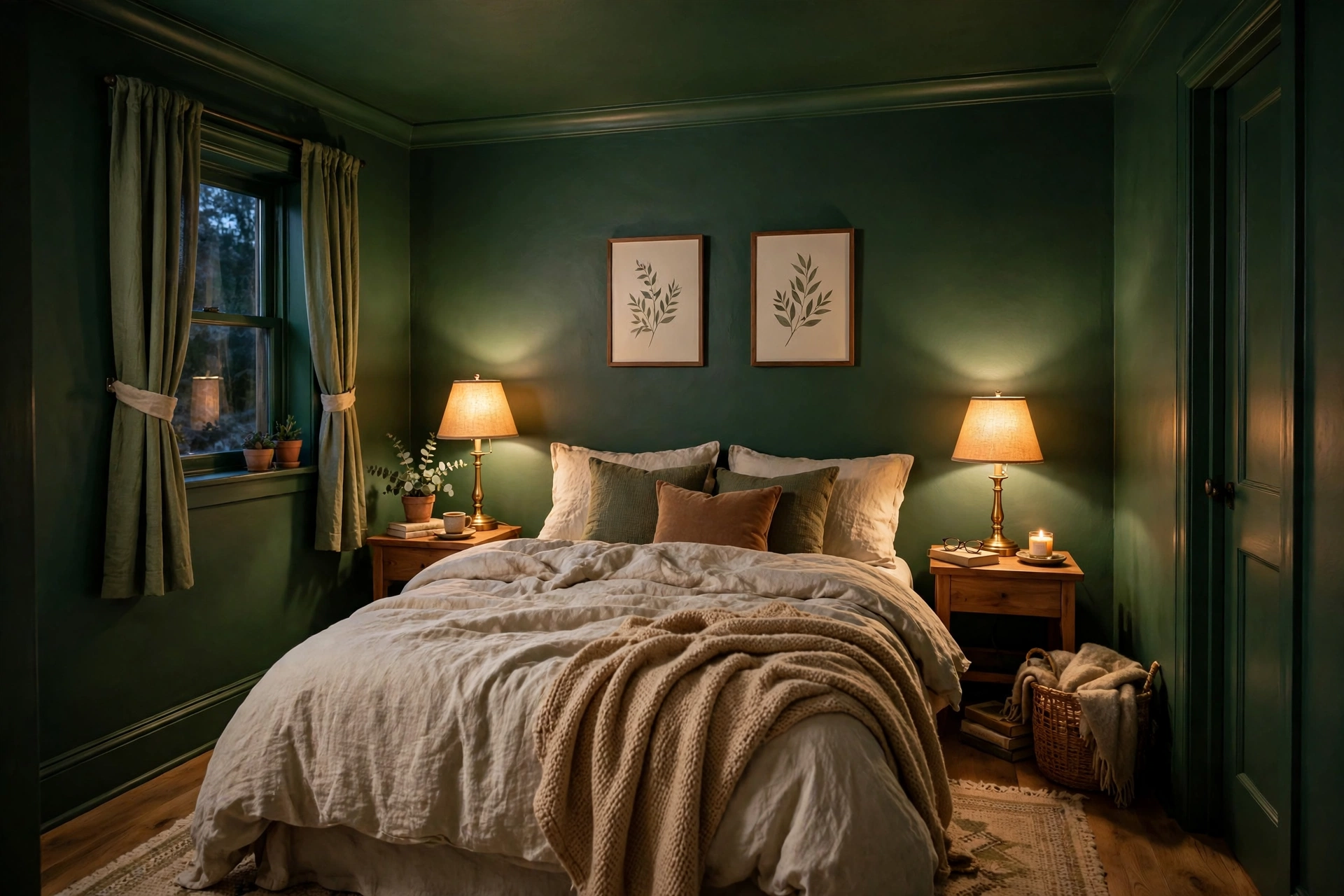
Deep green, navy or charcoal can make a small bedroom feel cozy and wrapped rather than cramped, but only if you commit. Paint the trim and ceiling in a related deep tone too, rather than leaving one dark wall floating in a white room.
If you’re not ready for that, use the dark color on one piece of furniture, a door or a single accent wall, and keep the rest light.
If you rent: test with large peel-and-stick samples or a painted board you can lean against the wall. You get the same light test without touching the landlord’s paint, and you’ll know what to ask permission for.
Committing fully to a dark color is the boldest move in how to choose paint colors for beginners, and it only works when trim and ceiling follow.
Quick Color Ideas by Room
These are starting points, not rules. Always test in your own light.
- Living room: Warm neutrals, soft greige, muted greens or earthy tones. Choose something you can live with for years.
- Bedroom: Low-contrast, calming shades such as soft sage, dusty blue, warm gray or a deep, moody color if you want it cozy.
- Kitchen: Light, warm tones keep the room bright. Satin or semi-gloss on cabinets makes cleaning easy.
- Bathroom: Pale, clean colors with a moisture-resistant finish. Small bathrooms can also handle a bold color for personality.
- Hallway: A light, forgiving shade in a washable finish, since it takes the most daily wear.
- Home office: Calm mid-tones, such as muted green or soft blue-gray, work well, and keep glare on the screen low.
Trying one room first is the safest way to practice how to choose paint colors for beginners before you take on the whole house.
How Much Paint Do You Need?
A gallon of paint typically covers about 350 to 400 square feet with one coat, but check the can, since coverage varies by brand and surface. To estimate, multiply the width of each wall by the room’s height, add the walls together, and subtract large windows and doors. Most walls need two coats, and a deep color over a light wall (or the reverse) may need a primer first. Buy a little extra for touch-ups, and write the color name, brand and finish on the lid for later.
Prep tip: Clean the walls, fill small holes, sand rough spots and tape edges. A good color painted on a messy surface will still look disappointing.
Knowing how much paint you need is another small skill in how to choose paint colors for beginners, because running out mid-wall wastes a day.
Common Mistakes to Avoid
- Choosing from a small card under store lights
- Ignoring undertones in the floor and fixed furniture
- Painting every room a different bold color
- Using a shiny finish on a bumpy bedroom wall
- Judging a sample for five minutes instead of a full day
- Skipping primer when changing from a very dark color to a light one
- Following a trend color that doesn’t suit your light
Avoiding these mistakes is the fastest way to succeed at how to choose paint colors for beginners without repainting.
A Simple Weekend Plan
Saturday morning: Note the light in your room and hold samples against the floor.
Saturday afternoon: Paint two large samples and live with them overnight.
Sunday: Check them in daylight, then in lamplight, and buy only what that room needs.
One room finished beats three rooms half painted.
Conclusion
If you follow this order, how to choose paint colors for beginners becomes a calm process instead of a gamble.
If you remember one thing from this guide to choosing paint colors, let it be this: test the color in your own light, against your own floor, before you commit. Paint is cheap to sample and expensive to redo.
Start with one room. Check the light, match the undertone, test two or three large samples, and choose the finish that fits the room. If you’d like help pulling the whole room together, read our guide to home decor and design ideas for lighting, layout and styling tips that go with your new color.