

How much water do you need? Ask ten people and you’ll get the same answer: eight glasses a day. It’s one of the most repeated health rules in existence — printed on posters, quoted by influencers, built into water bottle markings. It’s also, in its literal “everyone needs exactly eight glasses” form, not something science ever actually concluded.
The real research is more useful than the slogan, because it explains why your own number is probably different from your neighbor’s, your gym buddy’s, and the influencer telling you to drink a gallon a day. Here’s what large studies, sports science, and physiology actually say about how much water you need.
Where the “8 glasses a day” rule actually came from

The trail leads back to 1945, when the U.S. Food and Nutrition Board recommended adults consume about 2.5 liters of water daily. That much is often repeated correctly. What gets dropped, almost every time, is the sentence right after it: the board noted that most of this amount is already contained in prepared food.
In other words, the original recommendation was never “drink 2.5 liters,” let alone “drink eight glasses on top of your meals.” It was closer to “your total water intake, food included, should land around this range” — a very different instruction that got flattened into a catchy number over decades of repetition.
A widely cited 2011 analysis in the British Medical Journal by physician Margaret McCartney traced how the myth persisted partly through marketing: bottled water and hydration-product industries had a direct commercial interest in promoting the idea that ordinary thirst wasn’t a reliable guide and that constant deliberate drinking was necessary. That doesn’t mean hydration doesn’t matter — it clearly does — but it means the specific “eight glasses” figure was never derived from a study measuring optimal human water intake.
What official science actually recommends
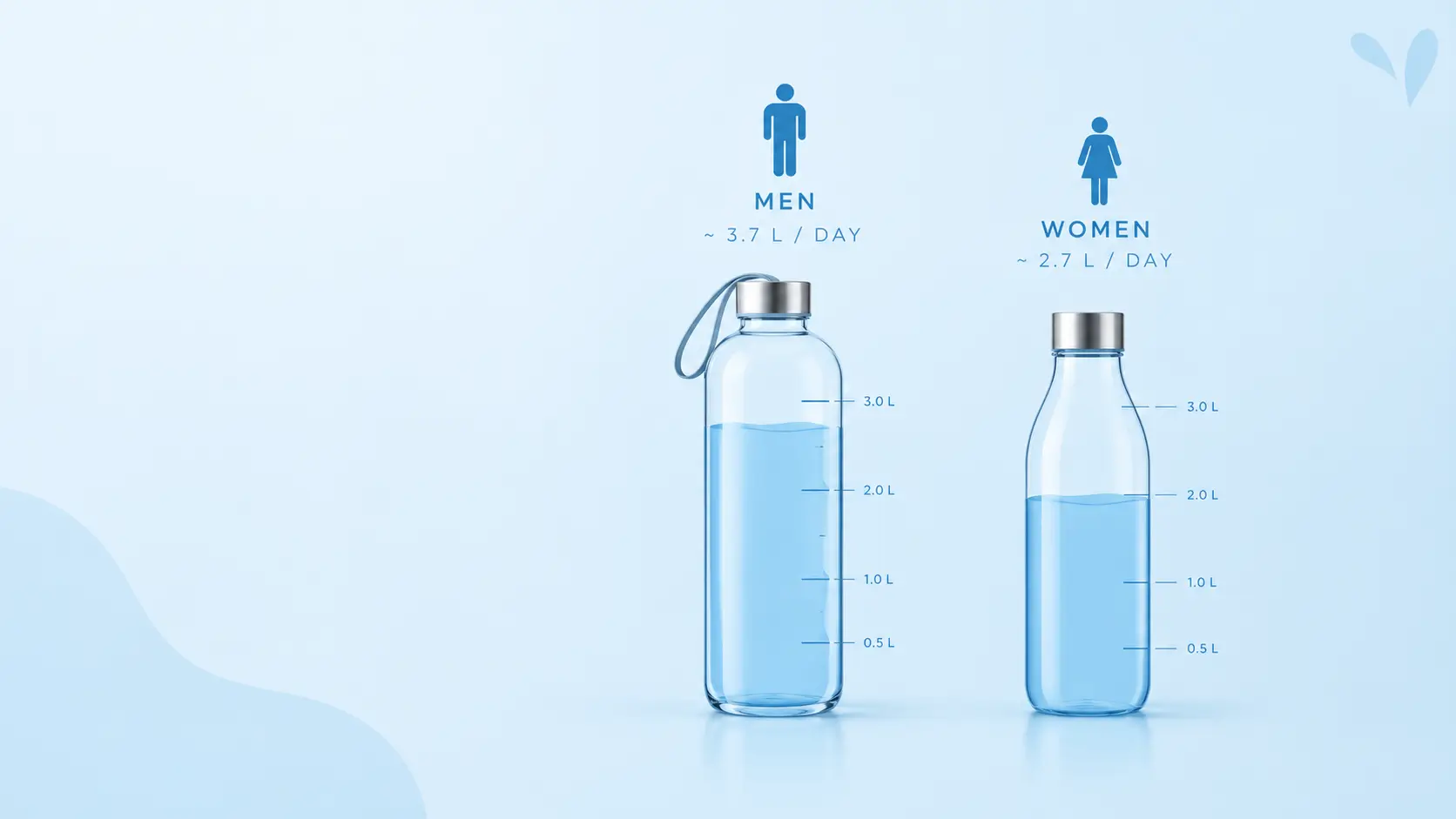
Health authorities that have studied this properly don’t converge on one number — because there isn’t one number that fits everyone. Two of the most cited bodies:
| Authority | Total Water (Men) | Total Water (Women) | Includes Food? |
|---|---|---|---|
| U.S. National Academies (IOM) | ~3.7 L/day (~15 cups) | ~2.7 L/day (~11 cups) | Yes, ~20% from food |
| European Food Safety Authority (EFSA) | ~2.5 L/day | ~2.0 L/day | Yes, food and drink combined |
Figures represent “total water,” meaning fluids plus water content from food. Roughly 20% of total water intake typically comes from food for most diets, more for diets rich in fruit and vegetables.
Notice these figures already answer the question of how much water do you need in a way the “8 glasses” rule can’t: they explicitly count food, they differ by sex, and neither body claims the number is precise for every individual. The IOM’s official report was explicit that it could not set a single average requirement because water needs vary too much with metabolism, activity, and climate to responsibly reduce to one figure.
What happens in your body when you’re dehydrated

Even mild dehydration — well before you’d call yourself “thirsty” in the classic sense — has measurable effects, which is part of why knowing how much water do you need matters beyond just comfort.
Researchers at the University of Connecticut’s Human Performance Laboratory ran controlled studies putting young men and women through mild dehydration of roughly 1.5% of body water, whether from light exercise or simply sitting without drinking. Both groups showed measurable declines in mood, and men and women showed somewhat different specific effects — concentration and vigilance problems were common, along with fatigue and headaches. Critically, the researchers found it didn’t matter whether the dehydration came from activity or from just not drinking: the deficit itself was what mattered.
A later pooled analysis of 33 studies, led by researchers at Georgia Tech and published in Medicine & Science in Sports & Exercise, confirmed the pattern at a population level: mild dehydration — as little as a 1–2% loss of body water, equivalent to sweating out roughly a liter — measurably impairs tasks requiring complex processing and sustained attention, even though it may not affect simpler tasks.
The uncomfortable part: your thirst mechanism typically doesn’t activate until you’re already at that 1–2% deficit. As UConn researcher Lawrence Armstrong put it, by the time you feel thirsty, dehydration has already started affecting how your mind and body perform.
How much water do you need during exercise?

Exercise is where the question of how much water do you need stops being a single number and becomes something you can actually calculate for yourself, because sweat rate varies enormously between individuals.
The American College of Sports Medicine’s position stand on fluid replacement recommends a simple, personal approach rather than a fixed volume: weigh yourself immediately before and after a typical workout. Each kilogram (2.2 lb) of weight lost during exercise represents roughly one liter of fluid that needs replacing — plus about 1.5 times that amount over the following hours, since some of what you drink is lost to urine before full rehydration is achieved.
Sweat rates vary widely — from under 0.5 liters per hour in mild conditions to over 2 liters per hour in heat or high-intensity effort, and men typically have measurably higher sweat rates than women doing comparable exercise. For sessions longer than an hour, ACSM recommends adding sodium to fluid replacement, since sweat carries meaningful electrolyte losses alongside water.
If walking is your main form of exercise, our guide to the health benefits of walking covers how much activity you actually need — useful context for estimating your own fluid needs on an average day.
How much water do you need in hot climates?

Heat and humidity change the equation substantially, and not just intuitively — heat exposure increases both sweat losses and the fluid needed for the body’s cooling system to function.
In hot environments, evaporative sweat cooling becomes the body’s primary way of shedding heat, which sharply increases fluid turnover even at rest. Research on people acclimatized to tropical and hot climates shows fluid replacement needs that can run considerably higher than temperate-climate guidelines suggest, and studies specifically note that current fluid guidelines developed largely in temperate research settings still apply reasonably well to people living and exercising in consistently hot climates, provided intake scales up with sweat losses.
Humidity matters as much as raw temperature. High humidity slows sweat evaporation, meaning your body sweats more to achieve the same cooling effect — so a humid 30°C day can demand more fluid replacement than a dry 35°C one.
Can you drink too much water?
Yes — and this is the risk almost never mentioned in “drink more water” advice, even though it’s medically well documented.
Exercise-associated hyponatremia (EAH) occurs when someone drinks more fluid than their body loses, diluting blood sodium to dangerous levels. A landmark study of the 2002 Boston Marathon, published in the New England Journal of Medicine, tested blood samples from 488 runners at the finish line: 13% had hyponatremia, and 0.6% had critical hyponatremia requiring medical attention. At least eight deaths from exercise-associated hyponatremia have been documented since 1985, almost all linked to runners overdrinking during long events rather than under-drinking.
The pattern that emerges from hyponatremia research is telling: races that reduced the number of aid stations along the course — cutting down on the temptation to overdrink — saw hyponatremia rates drop dramatically compared with races offering water every mile or two. Sports medicine bodies now explicitly advise athletes to drink according to thirst and measured sweat losses rather than a fixed schedule of “drink before you’re thirsty,” specifically to prevent overhydration.
This doesn’t apply only to marathon runners. Water intoxication has also been documented in military trainees and even in non-exercise contexts involving compulsive overdrinking. The takeaway: more water is not unconditionally better, and matching intake to actual losses matters in both directions.
Is thirst a reliable guide?
Mostly, yes — with two well-documented exceptions.
For most healthy adults going about an ordinary day, drinking when thirsty is a reasonably reliable way to meet fluid needs, and sports nutrition bodies increasingly emphasize trusting thirst over rigid drinking schedules, partly because it also protects against the overhydration risk above.
The exceptions: thirst lags behind actual deficit during exercise or heat exposure (as shown above, it typically doesn’t register until 1–2% dehydration has already occurred), and thirst sensation reliably weakens with age — older adults often don’t feel thirsty even when meaningfully dehydrated, which is part of why dehydration is a common, under-recognized problem in elderly populations.
Urine color is a more immediate, practical check than trying to consciously track ounces. Researcher Lawrence Armstrong’s original 8-color urine chart, validated against blood hydration markers, established that pale straw-colored urine indicates good hydration, while dark yellow or amber signals a deficit. It’s not perfectly precise — medications, vitamins, and some foods can shift urine color independent of hydration — but as a rough daily gauge, it correlates well enough with more invasive hydration measures to be genuinely useful.
Common hydration myths, debunked
- Myth: You need exactly 8 glasses a day. As covered above, this figure was never based on a study of optimal intake, and it ignores food-based water and individual variation entirely.
- Myth: Coffee and tea dehydrate you. While caffeine has a mild diuretic effect, the fluid volume in coffee and tea outweighs it for regular drinkers — these beverages count toward your total water intake, not against it, according to nephrology researchers who’ve studied the claim directly.
- Myth: Clear urine means perfect hydration. Completely clear urine more often signals overhydration than optimal hydration — pale straw yellow, not clear, is the target on validated urine color charts.
- Myth: You should drink before you feel thirsty. Current sports medicine guidance has moved away from this, precisely because it contributed to the overhydration and hyponatremia problem described above. Thirst-guided drinking is now the more evidence-backed default for most situations.
- Myth: More water always means better skin, more energy, or faster weight loss. Beyond correcting an actual deficit, there’s limited evidence that additional water intake improves skin appearance or metabolism in already-adequately-hydrated people; the benefits of hydration are real but don’t scale indefinitely with volume.
What the latest research says
Two threads of recent research are refining how experts think about how much water you actually need.
Better tools for checking hydration at home
Researchers at Arizona State University, led by Floris Wardenaar, recently developed and validated new multi-shade urine color charts, improving on Armstrong’s original 1994 design and making self-assessment more accurate across different lighting conditions and populations, including athletes, older adults, and pregnant or nursing women — groups where the original chart’s accuracy varied.
Individualized guidance over fixed targets
The clearest shift across recent sports nutrition literature is away from one-size-fits-all volume targets and toward individualized fluid replacement based on measured sweat rate, climate, and body size. Position papers from sports medicine bodies increasingly frame how much water do you need as a personal calculation — start weight minus end weight around exercise, adjusted for climate and duration — rather than a number that applies uniformly to a population.
How to build a practical hydration habit
- Use urine color as your daily check. Aim for pale straw yellow, not clear and not dark amber.
- Count food and other beverages. Coffee, tea, soup, fruit, and vegetables all contribute meaningfully to total water intake — you don’t need to hit a number in plain water alone.
- Weigh yourself around exercise occasionally to estimate your personal sweat rate, rather than guessing.
- Scale up in heat and humidity, and don’t assume a cooler, drier day requires the same intake as a hot, humid one.
- Trust thirst on ordinary days, but drink proactively during long exercise, heat exposure, illness, or if you’re older and know your thirst sensation is blunted.
- Don’t chase extreme intake as a wellness goal. Past meeting your actual needs, more water isn’t a proven performance or health upgrade, and very high intake carries real hyponatremia risk during prolonged exercise.
For the bigger picture on how hydration fits into daily wellbeing alongside sleep, movement, and nutrition, see our guide to healthy daily habits.
Taken together, the honest answer to how much water do you need isn’t a fixed number of glasses — it’s a target that shifts with your body size, activity, climate, and diet, best tracked with simple, practical signals like thirst and urine color rather than a rule invented decades before anyone tested it.
Not necessarily. The 8-glasses figure traces back to a 1945 recommendation that explicitly included water from food, not water on top of it. How much water you actually need depends on your body size, activity level, climate, and diet.
Yes. Despite caffeine’s mild diuretic effect, the fluid volume in coffee and tea outweighs it, and both count toward your total daily water intake rather than against it.
Yes. Exercise-associated hyponatremia, caused by drinking more than the body loses, has been documented in 13% of runners in one major marathon study and has caused documented deaths. More water is not always better.
Weigh yourself before and after a typical workout. Each kilogram (2.2 lb) lost equals roughly one liter of fluid to replace, plus about 50% more over the following hours to fully rehydrate.
Not necessarily — completely clear urine often indicates overhydration rather than ideal hydration. Pale straw yellow is the target on validated urine color charts.
Often yes. Thirst sensation reliably weakens with age, so older adults may need to drink proactively on a schedule rather than waiting to feel thirsty, since dehydration is a common and under-recognized issue in this group.
This article summarises published research for general information. It isn’t medical advice. If you have a kidney condition, heart failure, or another condition affecting fluid balance, talk to your doctor about what’s appropriate for you.
Key sources
- McCartney M. Waterlogged? BMJ. 2011;343:d4280.
- Ganio MS, Armstrong LE, Casa DJ, et al. Mild dehydration impairs cognitive performance and mood of men. British Journal of Nutrition. 2011;106(10):1535–1543.
- Armstrong LE, Ganio MS, Casa DJ, et al. Mild dehydration affects mood in healthy young women. Journal of Nutrition. 2012;142(2):382–388.
- Wittbrodt MT, Millard-Stafford M. Dehydration impairs cognitive performance: a meta-analysis. Medicine & Science in Sports & Exercise. 2018;50(11):2360–2368.
- American College of Sports Medicine. Position stand: exercise and fluid replacement. Medicine & Science in Sports & Exercise. 2007;39(2):377–390.
- Almond CS, Shin AY, Fortescue EB, et al. Hyponatremia among runners in the Boston Marathon. New England Journal of Medicine. 2005;352(15):1550–1556.
- Armstrong LE, Soto JA, Hacker FT, et al. Urinary indices during dehydration, exercise, and rehydration. International Journal of Sport Nutrition. 1998;8(4):345–355.
- Institute of Medicine (National Academies). Dietary Reference Intakes for Water, Potassium, Sodium, Chloride, and Sulfate. 2004.
- European Food Safety Authority. Scientific opinion on dietary reference values for water. EFSA Journal. 2010;8(3):1459.